
Plannning Design & Installation Tips
The size of a solar electric system depends on the amount of power that is required (watts), the amount of time it is used (hours) and the amount of energy available from the sun and wind in a particular area (sun-hours per day & wind average MPH). The user has control of the first two variables, while the third depends on the location.
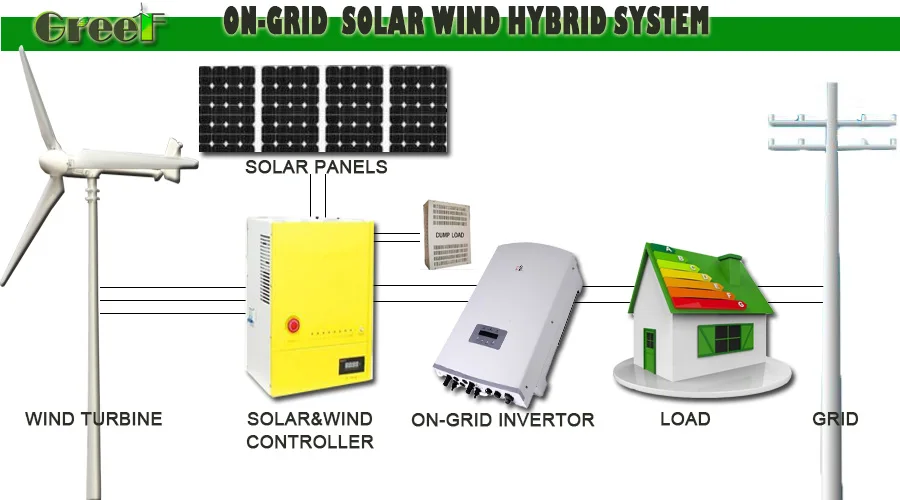
Solar Hybrid systems with DC generators have proven the most reliable due to reduced dependency on battery and eliminating the impact of errors in load sizing and poor weather. Using a Polar DC generator is preferred over the AC generator because our generators are engineered for long run times with minimal or no maintenance. Jan 06, 2017 Designing a solar-diesel-hybrid-system is quite complex. There are many values that have to be taken into account such as meteorological data, electrical parameters, sizing of the components, profitability and many more. Sunny Design is a free tool that makes designing a solar-diesel hybrid system super easy.
Estimate Your Loads. The BIG Question You Need to Answer First:

Solar And Generator Hybrid Systems Diagram

- List your loads. How many watts per day does or will your household consume? The most important challenge in an hybrid solar wind off-grid system is to balance your energy consumption with your supply of energy required. You cannot begin to do that without first knowing how much energy you need each day.
IE: 5 - 13 watt light bulbs X 5 hours per day = 65 watts. 18 CF refrigerator @ 5 amps x 120VAC = 600 watts x 6 hours per day = 3,600 watts. THIS IS IMPORTANT: When we say 'list your loads ', we mean all your loads. From the cell phone chargers to a hair dryer. Need Help? If you download the Excel worksheet you will only have to indicate how much of each piece of equipment you have and how long your run it.
Hybrid Solar Systems For Homes
Wind Turbine Site Selection & PV Sizing; Input Must Equal Output.
(A) The size and or number of solar panels is calculated from the total energy requirements + allowing for wire and inverter transmission loss (20% rule of thumb) less the lowest solar irradiance available in the area of the system which is usually the shortest daylight month of the year (December). In a hybrid system, you are not only considering the solar array but also the average available wind for your area. The combined input of both systems must equal your daily output during the shortest day of the year or you will certainly strain your battery bank capacity.
Choosing Your Battery Bank:
Battery bank sizing is the part of the hybrid solar wind system that has a higher probability of causing you problems that other parts of your system. Use the battery sizing worksheet to help you through this critical stage. Factors such as your budget may tempt you to look to cheaper battery alternatives but a quality battery will pay off over the years. We recommend you choose a 2VDC or 6VDC battery and connect them in series so that the total DC volatage equals the system voltage. Do NOT put more than 3 banks of batteries on one charge controller.
● Click the Battery Bank Size Tab Above ⇑ to Learn More.
Power Center
The MidNite Solar E-Panel MNEMS4448PAECL150-BMK pre-wired power assembly that features advanced solar power electronics for off-grid, backup and on-grid functionality in one unit. Flooded, Gel, AGM, Lithium-ion battery compatible. 48 VDC battery based inverter. The Magnum Energy 4400 Watt 120/240VAC 30 AAC output inverter produces pure sine wave clean electricity drawing power from the energy stored in a battery. NEC code compliant the MidNite 3600 Watt E-panel kit is mechanically and electrically engineered with every component specially selected to assure the highest performance in a safe simple-to-install DIY package. [● On-Grid Definition - Utility grid power is available for use and the system is will connect to work in parallel with the solar panels to recharge the battery bank but inverter/charger is not capable of exporting electricity (selling) back to the utility grid.]
Electrical Distribution Parts
Combiner / circuit breaker box is a key piece of equipment that begins to bring the system production together that allows you to generate electricity. NEC (National Electrical Code) says that each series of strings of panels are to be wired to it's own circuit breaker. Midnite Solar and OutBack combiner boxes make this task easy providing a breaker to turn off and on each string for any purpose. The combiner box is usually located directly under a ground mount array or on the wall directly below the roof mounted solar array in conjunction with a locally supplied junction box at the edge of the rooof arran. (Transition to conduit down to the combiner in that curcumstance.
Wire size and breakers are the final items in your hybrid solar wind design to consider, but no less important. To have a safe off-grid system, you will need to install breakers and choose the right size wire. If you select one of our pre-wired power systems with your kit, we do all the heavy lifting for you because right size breakers are pre-engineered and pre-wired into each of our power centers. You simply have to hang and connect it following our wire diagram which is supplied with all our kits. It is no accident you will only find Midnite Solar and OutBack combiner boxes built into our off-grid systems. They are reliable, UL listed and simple to install.
The distance between the combiner box, which is usually located near the solar panels, and the charge controller will be a factor in choosing the best string voltage for the charge controller and battery system. The higher the input voltage the smaller the wire can be for any given amount of power. For example, a system with a 12 volt battery and solar panels consisting of four 6.75 amp 12 volt DC nominal modules located at a distance of 40’ from the batteries could have the modules wired in series, parallel or series and parallel. Input design possibilities in this example are 12, 24, and 48 volts DC. If the panels was configured with the panels wired in parallel the input voltage would be 12 volts DC with an input current of 26 amps. The same panels wired in series would have an input voltage of 48 volts DC and an input current of 6.5 amps. In this example #1, the 26 amp 12 volts DC panels #1/0 wire, which is prohibitively expensive, would be required to limit voltage drop to 2% which is recommended for 12 volt DC systems. The same panels wired for 48 volts dc would only require a #8 wire. With the #8 AWG wire the 12 volt dc panels would have to be within 7’ of the batteries. The distance that #8 wire can be used is over 5 times greater at 48 volts DC than 12 volts DC.
Jadakiss songs list. Complete song listing of Jadakiss on OLDIES.com Jadakiss Songs List OLDIES.com COVID-19: Because of processes designed to ensure the safety of our employees, you may experience a delay in the shipping of your order.
The amount of current (amps) traveling through any electrical circuit depends on the size of the wire (AWG), the voltage of the array or battery bank, and the one way distance of the wire run. Lower AWG gauge wire has less resistance than larger gauge wire. The longer the distance of your wire run while using lower voltage the larger gauge wire you are going to need. That is the reason we highly recommend a 48VDC battery based system.